
Nash Parole and Probation Compared
Probation is a court-ordered community sentence or part of a sentence. It does not require a prior state-prison release. Parole is conditional release under older sentencing law, while post-release supervision follows many modern North Carolina felony prison terms. The North Carolina Post-Release Supervision and Parole Commission handles parole decisions and post-release supervision policy. NCDAC Community Supervision manages people in the community.
The offense date matters. Structured Sentencing ended parole for offenses committed on or after October 1, 1994. Most modern felony cases therefore involve post-release supervision, not a discretionary parole grant. Older Fair Sentencing and earlier cases may remain eligible for parole review. A Nash County court record may explain why probation began, while the NCDAC record shows whether that supervision is active.
| Status | How it starts | What to verify |
|---|---|---|
| Probation | A court orders community supervision, sometimes without prison. | Active status, supervision history, and assigned office. |
| Parole | The Commission conditionally releases a person sentenced under eligible older law. | Commission action, actual release event, and current supervision. |
| Post-release supervision | Supervision follows release from a modern felony prison term when the law requires it. | NCDAC release history, supervision start, and discharge status. |
- Discharge
- The formal end of a prison term or supervision obligation shown by the responsible agency.
- Absconder
- A person alleged to have stopped reporting to or maintaining required contact with supervision.
- Detainer
- A request or hold from another authority that may affect custody or release.
Verify Nash Post-Release Supervision
The NCDAC Offender Public Information Search covers state prisoners, probationers, and parolees. It also contains historical records. It does not contain Nash County jail records. Search by the seven-digit offender number when possible because it is more reliable than a name alone. If only a name is known, compare birth information, conviction county, status, and sentence details before accepting a match.
- Open the NCDAC offender search and select a status broad enough to include active supervision. “All” is useful when the present status is not known.
- Enter the offender number. If unavailable, search the legal name and use birth date, age, and other supplied filters to narrow the result.
- Open only a record whose identifiers match. Read incarceration and supervision sections separately because release from prison can coexist with active supervision.
- Note the supervision type, active or inactive status, start and end entries, and any listed office or location. Treat a blank field as unknown.
- Confirm the correct Community Supervision office through NCDAC before visiting. Ask for public status and routing information, not private case-management detail.
A current jail roster answers a different question. Someone may be on probation without ever entering NCDAC prison, or may have left prison and begun post-release supervision. The full Nash County released-inmate search path explains when to use the jail record, court case, and state history together.
Note: “Inactive” means no longer active in NCDAC prison or supervision, but the detailed history provides the stronger context.
Nash County Supervision Offices
An older NCDAC Nash resources sheet lists two Community Corrections contacts, one in Nashville and one in Rocky Mount. That split reflects two local service centers, but the source is several years old. Office assignments, phone routing, and public hours may change. Confirm the right office with the current NCDAC Community Supervision directory before reporting or traveling.
North Carolina Commission
Post-Release Supervision and Parole Commission
2020 Yonkers Road
4222 Mail Service Center
Raleigh, NC 27699-4222
919-716-3010
Parole.Commission@dac.nc.gov
The historical local contacts are 227 S Barnes Street in Nashville at 252-459-4554 and 305 Cokey Road in Rocky Mount at 252-446-2604. They are useful leads, not guaranteed current assignments. The Commission is also not a local probation desk. It addresses parole and post-release matters within its authority, while NCDAC routes day-to-day community supervision.
Nash Absconders Versus Wanted People
The Nash County Sheriff’s Most Wanted page displays names, photographs, and alleged violations. It is not a probation or parole absconder database. It is not a release list either. By contrast, the NCDAC search directory links the statewide offender and absconder tools used for supervision questions.
An absconder entry alleges lost contact or noncompliance with supervision. It does not by itself prove that the person is in Nash County jail. A wanted entry or warrant can also exist while someone is physically outside custody, and a recent arrest may take time to appear across systems. Check the list suited to the question, match identifiers, and confirm any custody event with the holding agency.
The official NCDAC absconder-search screen shows the proper state channel:
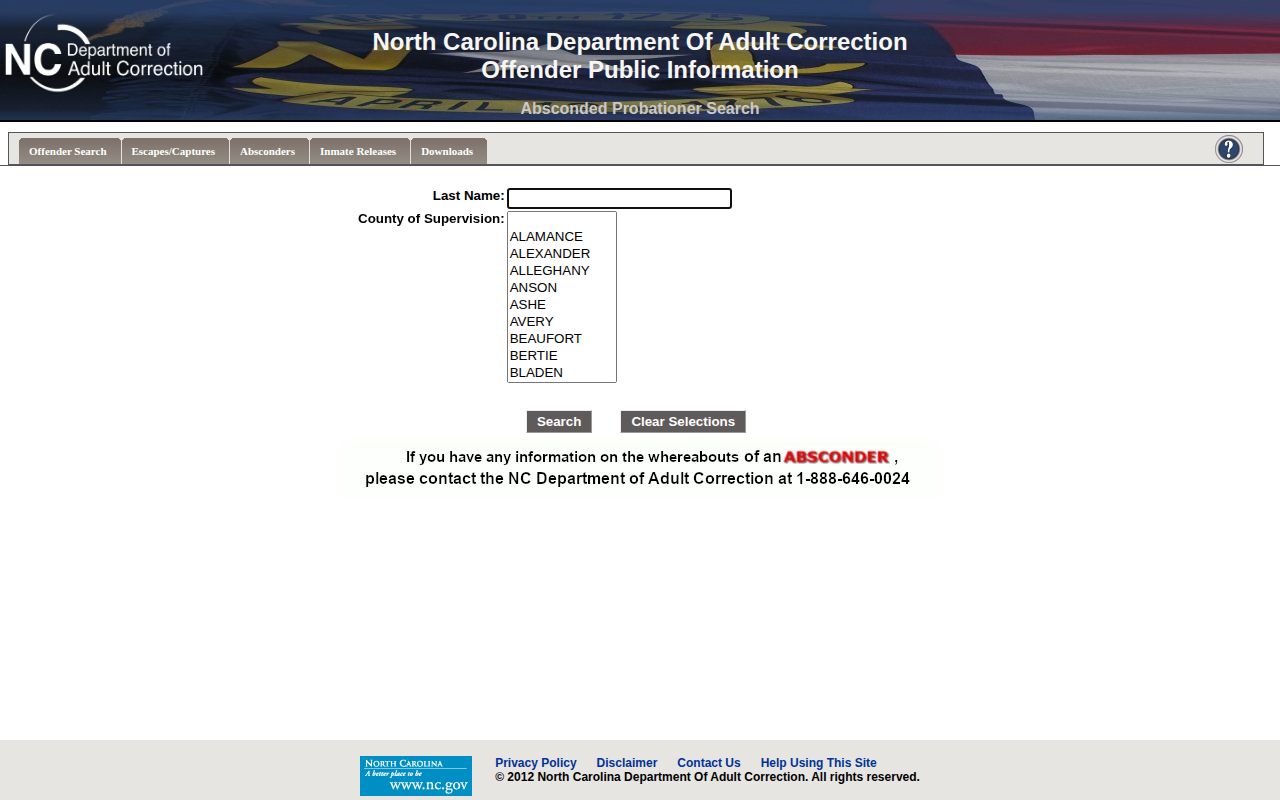
That screen concerns supervision contact status, not proof of a new jail booking or completed release.
Nash Parole Review Process
North Carolina does not publish a conventional, person-by-person Nash County parole hearing calendar. The Commission ordinarily does not hold formal hearings or meet face to face with an offender. Commissioners review files and vote on their own. A narrow exception permits some people convicted as juveniles and sentenced to life with the possibility of parole to appear by video conference.
The public cadence is the Commission’s monthly Discretionary Parole Reviews series. It has reported reviewed cases and decision groups since September 2024. The public results may use terms such as Incomplete Decision, Suspend Decision, Regular Parole, Community Service Parole, Early Medical Release, or 90-day Mandatory Parole. Individual denial reasons and underlying Commission records remain confidential.
A favorable vote is not the same as an executed release. Confirm the actual NCDAC incarceration event and the resulting supervision status after the set date. The offense date, judgment, sentence structure, and Commission record control eligibility. A conviction label by itself is not enough to calculate a review date.
The review record can also be incomplete by design. An “Incomplete Decision” means more information is needed, while “Suspend Decision” pauses the matter rather than granting release. Statutory denial grounds appear in G.S. 15A-1371(d), but the reason applied to one person is confidential. An interested party may learn that parole was denied and when the next review is due without receiving the full internal basis. For a Nash County case, keep the Commission result apart from the later custody event.
Nash Supervision Status and Violations
Supervision conditions come from the court, governing law, Commission action, and the person’s case. Public records may show the supervision type and broad status, but staff may not disclose private case notes or personal safety details. A violation may lead to added instructions, a court or Commission response, a warrant, or a return to custody. The public entry should be read as a status, not as a full account of the alleged conduct.
NC SAVAN, delivered through VINE/VINELink, includes probation and parole information as well as jail and prison custody. It can send custody-change notices by phone, email, text, or TTY. A SAVAN notice is useful for a change, but NCDAC warns that it should not be the only safety measure. A transfer notice also requires following the new agency.
Outside Prison, Still Incarcerated
A Nash-area NCDAC notice about Extending the Limits of Confinement, or ELC, illustrates why physical location is not enough. An ELC participant may live at home or in a transitional place yet remain legally incarcerated. NCDAC described ELC as neither early release nor commutation. A violation may return the participant to prison.
This status differs from Nash County’s EMPACT pretrial monitoring, parole, probation, and post-release supervision. Each has its own legal source and record trail. “Outside the prison” therefore should not be translated into “discharged.” Read NCDAC’s current status, incarceration history, and supervision entries together before drawing that conclusion.
Location words can be especially misleading after a Nash County prison movement. A person may leave Nash Correctional Institution for another prison and stay fully incarcerated. Another person may begin a supervised phase in the community. A third may remain under ELC while living away from the institution. The state offender number ties those changes to one history, while the status and event type distinguish transfer, release, supervision, and discharge.
Note: Release from a building, release from legal custody, and discharge from supervision are three separate events.
Nash County Supervision Discharge
Supervision ends through the action authorized by the judgment and governing law. The NCDAC history may change from active probationer or parolee to inactive after discharge. For a prison term, the actual release event and later supervision history answer separate questions. For probation, the court file can show an order that changes, revokes, or terminates the sentence, while NCDAC supplies the statewide supervision trail.
Use two records when the end date matters. Match the NCDAC offender record to the person, then obtain the relevant Nash County court order or ask the assigned office to confirm the public status. Do not treat the end of a projected term as proof that discharge occurred. Holds, new orders, and sentence changes can affect what happened, and the live agency record controls.
NC SAVAN may report a supervision or custody change, but it is not the formal discharge order. Save the notice as a prompt to check the source record. When NCDAC shows inactive status, read the final supervision event and dates rather than relying on the label alone. When the court changed probation, obtain that filed order from the Nash County case. This two-source check resolves both the legal action and the statewide status trail.