
Nash Projected Versus Actual Release
A projected or tentative release date reflects the facts and credits in the current sentence computation. It may move. An actual release date records an event that already happened. For someone who has left NCDAC custody, the incarceration history and actual release entry are stronger evidence than an old projection. A transfer date is different again because it shows movement between facilities or agencies, not the end of custody.
Nash County jail status requires a separate analysis. A person held before trial does not yet have a sentence release date. Bond, recognizance, dismissal, a court order, or another legal event may end the jail stay. A sentenced misdemeanant may have a term, confinement credit, and earned time administered by the lawful custodian. A person awaiting transfer after a felony judgment may soon shift from Nash records to NCDAC computation.
- Projected date
- A date estimated from the present sentence calculation and credits.
- Actual release
- The recorded event when a person departed the identified custody system.
- Time served
- Confinement already credited toward a sentence under the controlling record.
- Detainer
- A hold or request from another authority that may affect departure or destination.
Find Nash County Release Dates
Start with custody type. The NCDAC Offender Public Information Search covers state prisoners, probationers, and parolees, with history reaching back to 1972. It expressly excludes county jail information. A Nash County Detention Facility detainee will not appear there merely because the person was booked or released locally.
- Identify whether the person is pretrial in the Nash jail, serving a local sentence, awaiting NCDAC transfer, or in state prison.
- For NCDAC custody, search by the seven-digit offender number when known. Otherwise use the name and compare birth data, conviction county, and sentence information.
- Open the correct detail record. Review status, location, incarceration history, offense and sentence rows, admission, projected release, actual release, and supervision fields that are present.
- For a Nash jail sentence, contact the Detention Facility and obtain the court judgment and official credit record. Do not calculate from the charge alone.
- For a pretrial detainee, check the Nash court case and jail record for bond or a release order. No sentence date exists yet.
- Confirm the live computation with NCDAC or the lawful jail custodian when a displayed field is blank, old, or unclear.
The complete Nash County release search separates Sheriff, court, state, and notification sources. That distinction prevents a state date from being assigned to a county-jail stay.
Note: An offender number is the strongest search key, but every match still needs identity and sentence checks.
NCDAC Release Fields for Nash
The main NCDAC form can filter All, Active Inmate, Active Probationer/Parolee, or Inactive. It accepts name, offender number, gender, race, ethnicity, birth date with tolerance, and age range. “Inactive” means formerly active in prison or supervision but no longer active. That label can locate an older case, but the detailed actual release entry supplies better evidence of a completed custody event.
The live public record may show current status and location, incarceration and supervision history, sentence entries, conviction county, admission date, Projected Release Date, and Actual Release Date. Availability changes by sentence era and record. An empty field is not permission to derive a day from a maximum term. The exact label displayed on the live record should be quoted accurately.
The official NCDAC search screen shows the statewide route used for Nash state prisoners:
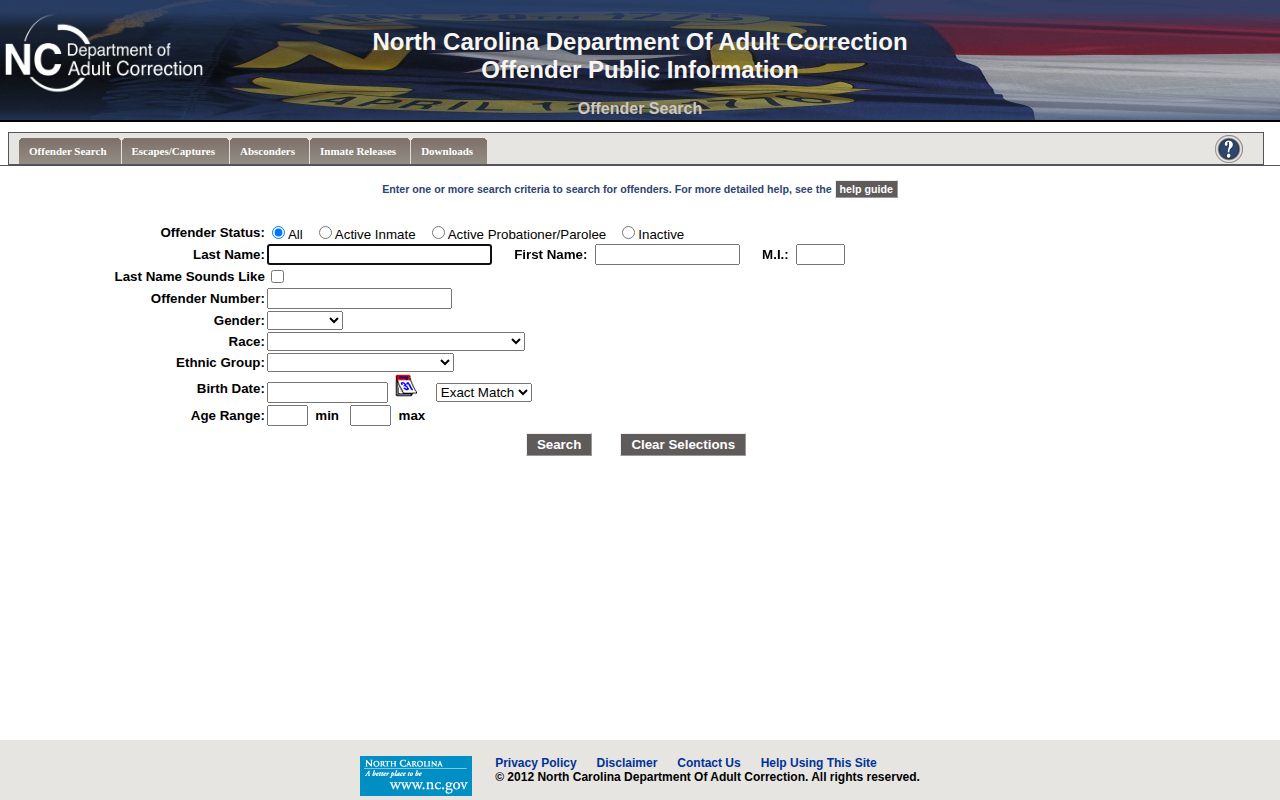
This statewide form does not search releases from the Nash County Detention Facility.
Nash Release Dates and Earned Time
North Carolina Structured Sentencing uses minimum and maximum terms plus earned time. It does not apply one universal release percentage to every Nash County case. Under G.S. 15A-1340.13, the felony judgment states an authorized minimum and corresponding maximum. NCDAC may award earned time under subsection (d), but that credit may not reduce the term below the minimum except where another legal rule permits it.
G.S. 148-13 directs NCDAC to adopt rules for earning, forfeiting, and applying credits. Its subsection (e) makes those regulations applicable through local jail administrators for sentenced jail prisoners. For an activated misdemeanor, G.S. 15A-1340.20(d) caps earned time at no more than four days per month.
Presentence confinement credit may also affect a county sentence. So can concurrent or consecutive treatment, sentence corrections, and restored or forfeited credit. The judgment and the official credit record must be read together. A charge description, sentence maximum, or informal “time served” statement is not enough to compute a guaranteed day.
The minimum and maximum serve different roles in the North Carolina structure. The minimum is not automatically the exact exit date, and the maximum is not a safe date from which to subtract a stock percentage. Earned time operates under agency rules and statutory limits. Post-release supervision is built into the maximum-term structure for covered felonies. For a Nash County sentence, the correct task is to locate the official computation, not recreate it.
Why Nash Release Dates Change
A projection can change without error. The date reflects the agency’s current data and legal calculation. Some changes affect the sentence itself; others affect the day or destination of physical departure. A move from Nash Correctional Institution to another NCDAC prison changes the facility departure but does not reset the state sentence.
| Factor | Possible effect | Best confirmation |
|---|---|---|
| Earned credit | Eligible credit can advance the projected date within legal limits. | NCDAC or jail credit record. |
| Discipline | Credit may be forfeited or later restored under applicable rules. | Official sentence computation. |
| Jail credit audit | Corrected presentence credit may alter the calculation. | Judgment and custodian record. |
| Court order or appeal | A corrected or new order may change the sentence. | Filed court order and agency update. |
| Concurrent or consecutive terms | The relation between sentences affects the overall term. | Judgment and NCDAC computation. |
| Detainer or new sentence | Departure may lead to another agency or another term of custody. | Holding agency and destination record. |
| Parole decision | An older-law case may receive, lose, or await a parole date. | Commission action plus actual release history. |
Some offenses also carry special terms or exclusions. The broad rules cannot replace review of the individual judgment. If NCDAC’s public field does not resolve the question, ask Constituent Services or the appropriate records channel for the current official computation using the offender number and exact field requested.
Be precise about the question sent to the agency. Ask for the current projected release date, the actual release event if it has occurred, and the sentence or credit entry that governs the answer. A focused request is easier to route than a demand for every record. If a detainer changes the destination rather than the sentence end, ask which agency will take custody next.
Nash Release Dates After Parole
Parole is sentence-era specific. Structured Sentencing eliminated parole for offenses committed on or after October 1, 1994. A modern Nash County felony case therefore does not usually have a legacy parole eligibility date. Post-release supervision instead begins as part of the statutory sentence structure when required.
Older Fair Sentencing and earlier cases may remain under the North Carolina Post-Release Supervision and Parole Commission. A favorable Commission decision is not the same as actual release. The Commission may set a future date or require more action. Confirm the NCDAC actual release event and ensuing supervision status once the date passes.
Do not infer eligibility from the offense name alone. The offense date, judgment, sentence aggregation, specialized law, and official Commission calculation all matter. A projected release field and a parole review date answer different questions.
Note: Post-release supervision is not a sentence discount; it is a separate supervised phase after the prison release event.
Outside Nash Prison, Not Discharged
An NCDAC Nash-area Extending the Limits of Confinement notice shows a less obvious status. A participant may reside at home or in a transitional place yet remain legally incarcerated. NCDAC stated that ELC is neither early release nor commutation. If the person violates the terms, NCDAC may return the participant to prison.
That means physical location cannot replace the legal status field. Someone outside Nash Correctional Institution may have transferred, entered ELC, begun post-release supervision, or discharged. Each outcome has a different record. Read the incarceration history, current status, actual release event, and supervision history as a set before saying the sentence ended.
EMPACT is different. It is Nash County’s electronic-monitoring alternative for selected pretrial defendants, not an NCDAC sentence-credit program. A person released from secure jail into EMPACT has not completed the criminal case merely because the person is outside the facility.
These labels also affect how a projected date should be read. A facility departure date may mark transfer from Nash Correctional Institution while the NCDAC sentence continues. An ELC placement may change the residence without ending legal incarceration. Post-release supervision follows an actual prison release but is not the same as full discharge. The event name and current legal status are more useful than physical location alone.
Confirm a Nash Release Date
For a state prisoner, compare the live NCDAC record with the sentence and actual release history. For a Nash jail sentence, contact the Nash County Detention Facility at 252-459-1536 and obtain the court judgment and custodian’s official release computation. For a pretrial person, use the court order and jail entry/release record because there is no earned-time projection to find.
NC SAVAN can add notice of a pending custody change. Register through the Nash County VINELink check, keep the four-digit phone PIN private, and follow any transfer destination. SAVAN notification may lag and is not a durable release document. Ask for the underlying agency record when proof of the actual event is needed.
A release from one system does not rule out another hold. Confirm the destination as well as the date. For someone already released, the actual event supersedes the older projection.
Record the date on which the source was checked. A projected field may change after that point, while an actual release entry describes a completed event in that system. When an agency gives an oral answer, ask which record supports it and request that record if written confirmation is needed. This keeps a Nash County estimate, court order, custody transfer, and completed release from being blended into one date.